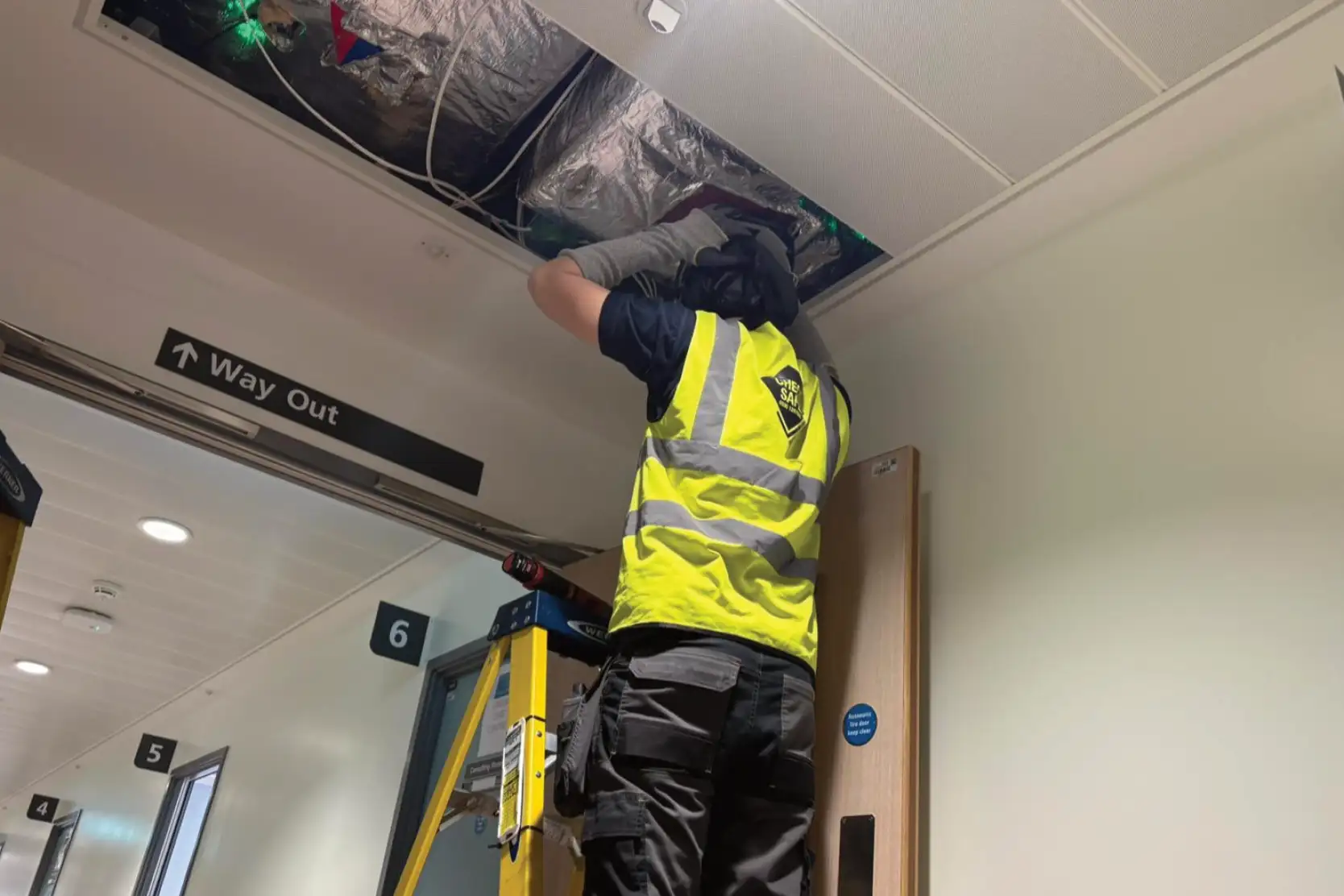
In most buildings, fire safety is visible. Alarm call points sit on corridor walls, while fire extinguishers are mounted where they can be reached, emergency lighting clearly highlights escape routes, and fire doors are labelled, inspected, and frequently discussed. Yet, within ceilings and ductwork, another critical life safety system often goes unnoticed – and, in many cases, unmanaged.
Across almost every sector we work in – from multi-occupied residential buildings to healthcare estates, education campuses, and commercial portfolios – fire dampers tend to come to attention during broader surveys. Often, they are identified during compartmentation inspections or intrusive investigations, revealing assets that have not been tested for years and, in some cases, are not even recorded on an accurate asset register.
Unlike more visible systems, there are no daily cues to prompt attention, no obvious signs of wear and tear, and rarely a named individual responsible for their management. This hidden nature, along with limited awareness of their critical role, means fire dampers can remain overlooked – even though their failure can compromise the integrity of an entire fire strategy.
What are fire dampers?
Fire dampers are mechanical devices installed within ductwork and ventilation systems to prevent the spread of fire and smoke between compartments. When heat from a fire activates them, fire dampers automatically close, helping preserve compartmentation, protect escape routes, and support the overall fire strategy of a building.
Despite their critical function, fire dampers are often unseen and undermanaged. With no visible indicators of deterioration and limited day-to-day oversight, responsibility for their presence and performance may not be clearly assigned. When fire dampers are missing, damaged, inaccessible, or simply untested, the integrity of an entire fire strategy can be compromised – and sometimes without the responsible person even being aware.
Under the Regulatory Reform (Fire Safety) Order 2005 (RRFSO), fire safety measures must be maintained in an efficient state, working order, and good repair. Fire dampers are categorised within these measures. Where a building falls within the scope of the RRFSO, the responsible person holds the duty to ensure that systems designed to prevent the spread of fire and smoke are properly maintained and capable of performing as intended should a fire break out.
Why fire dampers are overlooked – and the risks that follow
Even though fire dampers play a vital role in life safety, they are frequently neglected in day-to-day building management – driven by limited visibility, unclear responsibility, and poor record keeping.
Fire dampers are hidden within ceilings and ductwork, so there are no obvious visual cues of deterioration. Unlike fire doors or alarm systems, they are not regularly discussed during routine inspections, and buildings may not have a named individual accountable for their oversight. While legislation places a clear duty on the responsible person, in operational reality, this is often diffused across estate teams, managing agents, facilities providers, and specialist contractors. Without a well-defined allocation of oversight, fire dampers can fall between contractual scopes – assumed to be covered but often not actively managed.
This lack of attention is compounded by incomplete or outdated asset registers. Many organisations only discover the true extent of their fire damper inventory during wider surveys or intrusive inspections, when previously unrecorded or untested units come to light. Without a structured programme of inspection, testing, and maintenance, fire dampers can remain in an unknown condition for years – creating a risk that a fire could spread between compartments undetected, undermining even the most carefully designed fire strategy.
Operational challenges also play a role. Teams managing multiple buildings often face dispersed portfolios, competing priorities, and constrained budgets. Ensuring fire dampers are inspected, documented, and maintained requires coordination, visibility, and expertise – the very things that are often missing when responsibility is unclear.
Integrating inspection, testing, and maintenance
Once fire dampers are identified, effective management can move beyond awareness into demonstrable compliance. Under the RRFSO, it is not enough that these fire safety systems simply exist – they must be regularly inspected, maintained, and capable of performing their intended function. Many buildings only discover the condition of their fire dampers during wider surveys, but ongoing compliance requires a proactive approach. Regular inspections should verify that fire dampers are accessible, correctly installed, and capable of closing as designed in the event of a fire. Testing ensures full mechanical operation, while any faults or obstructions can be promptly addressed. Ensuring inspection and testing are carried out by competent specialists is critical to achieving reliable results and meaningful assurance.
Furthermore, clear asset records are essential. Accurate registers and certification go far beyond supporting operational efficiency. They provide evidence that the responsible person has taken reasonable steps to manage risk and, in an environment of increasing scrutiny, the ability to demonstrate oversight is as important as the physical condition of the asset itself.
When inspection and maintenance are integrated into wider fire safety programmes – alongside fire doors, compartmentation, and active systems – organisations gain confidence that fire dampers are not only present but functioning as intended. This structured approach turns a hidden life safety system into a reliable part of a building’s fire strategy. In addition to regulatory compliance, insurers increasingly expect organisations to demonstrate that critical fire protection systems are properly and appropriately maintained. In the event of a fire, insurers may request evidence that all fire protection measures – including fire dampers – were inspected and maintained according to these recognised standards. However, where records are incomplete or maintenance neglected, this can complicate claims and, in some cases, affect the outcome of insurance coverage.
From discovery to remediation and closing the compliance gap
All this said, the most significant challenge often does not begin at identification, but at remediation. Once surveys reveal missing, inaccessible, or non-compliant fire dampers, the scale of corrective work can be substantial. Access constraints, ceiling removals, service disruption, and coordination with other trades can turn what appears to be a straightforward maintenance issue into a complex programme of works.
At Checkmate Fire, we frequently see the impact of this type of reactive discovery. In older buildings, limited documentation and historic alterations can make locating and accessing fire dampers particularly difficult. Meanwhile, in newer estates, we may come across poor or inaccessible installations, misalignment with initial designs, or contamination and dirt preventing fire dampers dropping properly. In both cases, remediation requires careful planning to minimise operational disruption while restoring compliance and maintaining building functionality.
This reactive approach is further compounded when programmes rely solely on intrusive investigations, which often uncover issues at a late stage, compressing timescales and increasing budget pressure. Through structured surveys, prioritised remediation plans, and coordinated delivery, Checkmate Fire supports organisations in moving from reactive correction to managed, risk-based improvement.
Ultimately, managing fire dampers effectively is not simply about inspection frequency. It is about awareness, governance, visibility, and long-term oversight. By embedding fire damper compliance within a planned asset management strategy, organisations shift from uncertainty and fragmented information to clarity and control.
Facilitating the ‘golden thread’ of information
Effective fire damper management is not to be considered in isolation. It forms part of a broader requirement for accurate, accessible, and traceable fire safety information – this is referred to as the ‘golden thread'.
For higher-risk buildings in particular, the principle of the golden thread reinforces the crucial need for clear documentation of fire safety systems throughout a building’s lifecycle. However, the underlying expectation extends beyond a single building type – those responsible for fire safety should understand what systems are in place, where they are located, their condition at last inspection, and how they are maintained.
Fire dampers often expose weaknesses in this chain of information and, at Checkmate Fire, we consistently see how the absence of structured golden thread documentation creates avoidable risk and uncertainty. Missing asset registers, unclear maintenance histories, and fragmented responsibility continue to highlight gaps between installation, inspection, and oversight. Without reliable records, it becomes difficult to demonstrate that fire dampers (and the compartmentation strategy they protect) remain effective.
The answer is to embed fire damper data within a structured information management approach, strengthening compliance, improving decision making, and reducing reactive risk. When inspection records, certifications, access constraints, and remedial actions are documented and retrievable, organisations can expect to move closer to achieving a true golden thread. These critical systems will always remain hidden physically, but will instead be visible through robust governance information.
Building confidence in fire damper compliance
Managing fire dampers effectively requires more than simply identifying and testing assets. It demands informed interpretation of regulatory duties, clear allocation of responsibility, robust documentation, and the ability to carry fire safety intent through inspection, remediation, and ongoing maintenance. As expectations around compliance and the golden thread continue to evolve, organisations need assurance that concealed systems are not only present but demonstrably effective.
By combining technical expertise with practical experience across compartmentation and passive fire protection, Checkmate Fire supports organisations across a breadth of sectors to turn uncertainty into confidence and control. Through structured surveys, coordinated remediation, and clear information management, we help ensure that fire dampers remain fully integrated within a building’s wider fire strategy – today and as requirements continue to develop.